Automation in Brave New Wonders
Design modular production cells with movers, miners, signals, and blueprints — then clone what works across the archipelago.
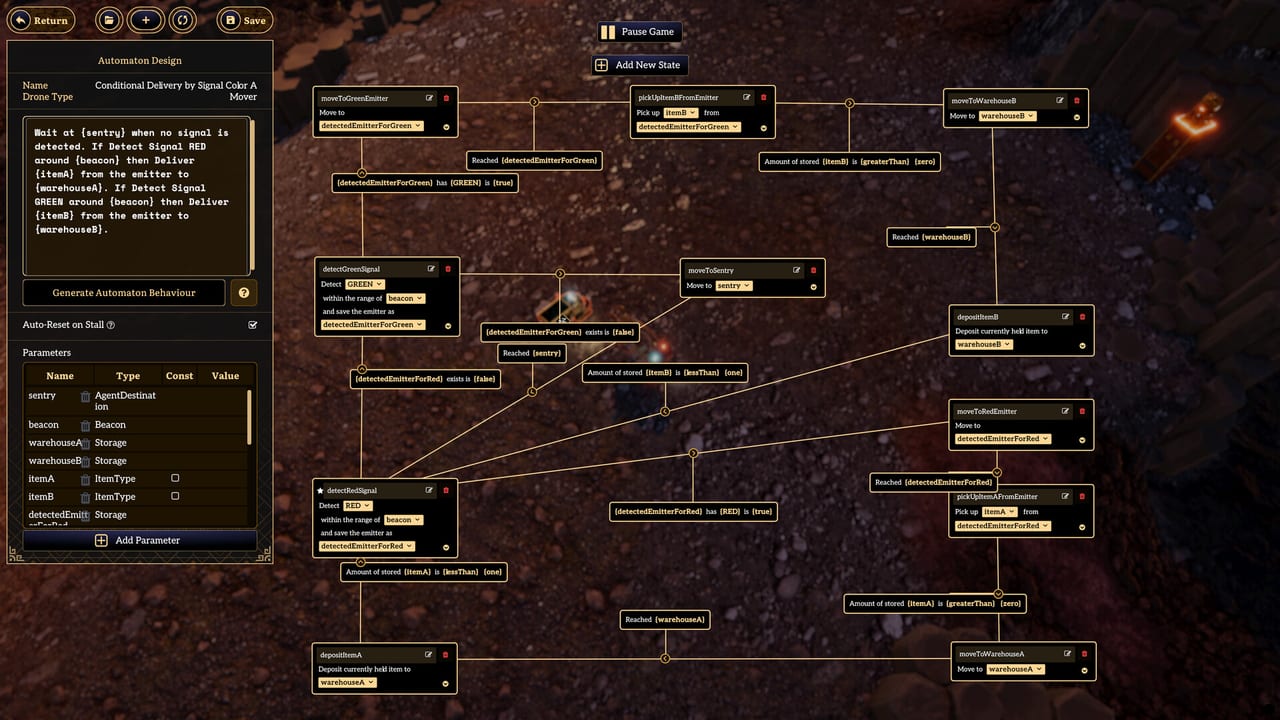
Automation in Brave New Wonders means teaching automatons to keep a factory alive without conveyor belts. You scale by clarifying tasks, signals, and blueprints, not by widening a main bus. This guide assumes you can already open the behaviour editor and survive the Americas opening — if not, finish Getting Started and Text Commands first.
The unit of scale is the cell
Stop thinking in infinite spaghetti. Think in cells: a small layout that turns one or two inputs into a reliable output, defended just enough to keep running, and saved as a blueprint. A cell usually includes:
- Resource interface (mine face, import pad, or airship unload)
- Processing buildings for ore, crystal, sand-to-glass, water, or fusion-cell steps
- Miner and Mover assignments with named behaviours
- Signal contracts between producers and haulers
- A tiny buffer storage so combat stutter does not stall everything
- Turret coverage or a retreat path (see Defense)
When a cell is trustworthy, blueprint it. Paste it. Fix labels. Clone automatons that already know the jobs. That loop is the Brave New Wonders growth engine.
Resource chains worth stabilizing early
Prioritize chains that unlock options rather than vanity throughput:
- Ore — foundation for structural and machine crafting.
- Crystal — often gates advanced components; keep a dedicated haul path.
- Sand to glass — easy to under-staff; Movers spend surprising time on bulk sand.
- Water — easy to forget until a recipe stalls mid-push.
- Fusion cells and related power logistics — treat power as a first-class product, not a background utility.
Each chain should have an owner behaviour set. Avoid one heroic Mover that “does everything somewhere.” Heroic Movers do not clone cleanly.
Signals: your invisible splitter network
Colored signals replace a large share of circuit box logic from other factory games. Establish a color legend per island (or per blueprint family):
- Green: batch ready / proceed to pickup
- Yellow: buffer high / slow input
- Red: hazard / retreat to safe storage
- Blue: airship or Wonder logistics window (once unlocked)
Document the legend in behaviour names. When two pasted cells disagree on what green means, you will invent bugs that are really dialect clashes. The text-commands guide shows how to phrase waits; automation is where you enforce the dialect across dozens of buildings.
Blueprint discipline
Blueprints in Brave New Wonders are not only geometry — they are promises about which behaviours belong where. Good practice:
- Blueprint only after three clean production cycles
- Include signal emitters and receivers in the footprint
- Leave margins for turret arcs and automaton pathing
- Version names (
GlassCell_v3) so you know which paste is current - After paste, verify that cloned automatons kept the intended tasks
If a paste misbehaves, check task retention before rebuilding recipes. Many “broken blueprints” are actually correct buildings paired with leftover wartime commands.
Throughput without belts
Belt games solve congestion with undergrounds and balancers. Here you solve it with:
- More Movers on saturated routes (after signals say demand is real)
- Shorter paths and local buffers
- Splitting a cell into parallel twins instead of one mega-cell
- Staggered signal timing so clones do not sync into traffic knots
- Parking / idle points that do not block deposit tiles
Watch for path crossing near furnaces and airship docks. A beautiful graph still fails if twelve Movers choose the same corner every tick.
Modularizing for the airship Wonder
Your mid-game unlock path runs through the Sky Pillar and the first Wonder: a massive airship that carries factories between islands. Automation that cannot be lifted is automation you will rebuild under fire on Europe or Africa. Design cells as liftable modules:
- Externalize island-unique resource IDs behind local labels
- Keep power and fusion logistics attachable at the edge
- Avoid one-off terrain snaps that only exist on the Americas starter rock
Read Wonders before your first major lift, and Islands before you specialize modules per biome.
Quality-of-life habits for long sessions
- Keep a lab corner for parser experiments so production cells stay clean.
- After patches, re-test one cell of each family — follow Updates.
- Rank which cells and presets deserve duplication via the Tier List Hub.
- When the fleet grows confusing, regroup names on the Players Hub style of thinking: roles, not vibes.
- Store official references on the Links Hub so you are not hunting Steam comments mid-design.
Failure modes and fixes
Starvation despite full mines. Usually a missing signal wait or a Mover still bound to an old deposit.
Oscillation. Two behaviours fight over the same buffer. Add priority language or separate storages.
Clone storms. You duplicated a half-finished behaviour. Delete clones, fix source, re-clone.
Combat collapse. Logistics paths crossed patrol routes. Pull hauling inside turret umbrellas; see defense guide.
Post-lift breakage. Labels were world-absolute. Rewrite behaviours to blueprint-local roles before the next voyage.
A sample scaling plan
Hour 1–2: one ore cell, one sand cell, shared water, minimal turrets. Hour 3–5: crystal specialty cell, glass twin cells, signal legend locked, first serious blueprint library. Pre-Pillar: fusion-aware power cell, defense ring that does not choke pathing, airship dock rehearsal footprint. Post-Wonder: biome kits — Americas bulk ore, Europe/Asia/Africa variants as you scout (Islands).
Related guides
- Text Commands — write the behaviours worth cloning
- Defense — protect the loops you just built
- Wonders — move factories with the airship
- Getting Started — reopen if your foundation still wobbles
Brave New Wonders automation is literary engineering: short clear jobs, honest signals, and blueprints you would trust on another island. Master the cell, and the archipelago becomes a network instead of a series of restarts.
Frequently Asked Questions
Quick answers to the most common Pioneer questions.
How do I automate without conveyor belts?
Assign Miner and Mover behaviours, coordinate buildings with colored signals, and scale by blueprinting modular cells. Clone automatons only after their tasks prove stable.
Why should I blueprint small cells instead of one huge base?
Small cells paste cleanly, clone predictably, and lift more easily with the airship Wonder. Huge unique bases break when labels and pathing are island-specific.
Do cloned automatons keep their tasks?
Yes. That is why you must perfect the source behaviour before cloning. Mistakes multiply at the same speed as success.
What resources should I automate first?
Stabilize ore, crystal, sand-to-glass, water, and early fusion/power logistics before chasing exotic side chains.
How do signals help factory throughput?
Signals gate pickups, pause inputs when buffers are high, and coordinate retreats during raids — replacing much of the circuit logic belt games use.
When do I prepare automation for island travel?
Before unlocking and using the Sky Pillar airship Wonder. Design liftable modules with local labels so Europe, Asia, and Africa pastes do not inherit Americas-only wording.